
Yes, you can sell a house with foundation problems in Charlotte — you have two honest paths. You either fix it and list it, or you sell it as-is to a cash buyer who prices the repair in. Which one puts more money in your pocket depends on one thing: whether the damage is cosmetic or structural. Get an independent engineer’s report before you decide anything, because that $300–$800 tells you which road you’re actually on.
I’m Ryan Whitcher, and my team and I run Harmony Home Buyers here in Charlotte. We’ve bought a lot of houses across Mecklenburg where the foundation was the whole problem. One that sticks with me was a 4,000-plus-square-foot home in Mint Hill facing well over $100,000 in repairs — the owner had no interest in fronting that kind of money or paying a commission on top of it. We bought it as-is and he walked away clean. Foundation issues are the single most common reason a Charlotte seller ends up talking to someone like me.
Why Charlotte Houses Crack: It’s the Red Clay
The reason foundation problems are so common here isn’t bad builders. It’s what your house is sitting on. Charlotte sits on Piedmont red clay, and that clay is what engineers call expansive — it swells when it soaks up water and shrinks when it dries out. Every wet spring and dry summer, the ground under your foundation is quietly moving, and over years that movement shows up as settling, cracks, sticking doors, and drainage problems.
You see it differently depending on where you live. In older neighborhoods like Dilworth and Plaza Midwood, a mix of crawl spaces and basements on hilly terrain is a recipe for bowing walls and water intrusion, and renovating a 1950s home there often uncovers decades of deferred maintenance. Meanwhile the newer builds from the ’90s and 2000s across south Mecklenburg sit on that same heavy, reactive clay — newer house, same underlying pressure.
Cosmetic vs. Structural: The Distinction That Decides Everything
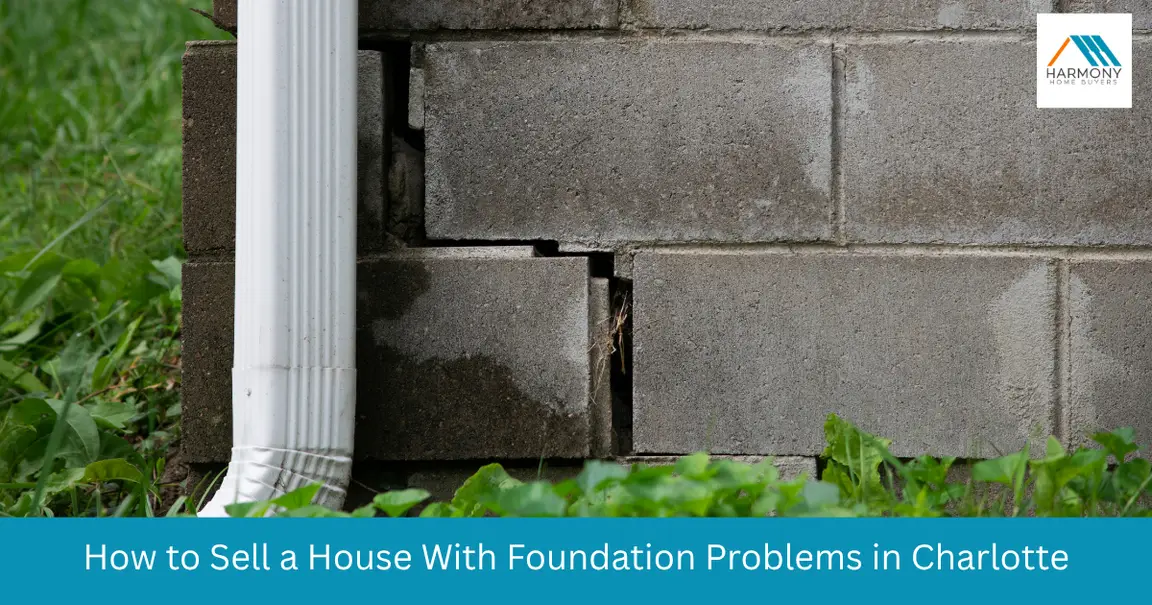
Not every crack is a crisis, and this is where a lot of Charlotte sellers either panic too early or ignore a real problem too long. Hairline cracks in drywall, thin cracks in a slab, small settling — often cosmetic. Stair-step cracks through brick, horizontal cracks in a foundation wall, doors and windows that suddenly won’t close, floors that slope — those point to structural movement.
You cannot eyeball this reliably, and neither can I. Spend the $300–$800 on an independent structural engineer’s report before you spend a dime on repairs or talk to any buyer. That report is the most valuable thing you can hold in this whole process, because it turns a scary unknown into a number.
What Foundation Repair Actually Costs Here
Here’s the honest range for the Charlotte market. Minor repairs commonly run $2,000–$15,000, with a lot of jobs landing somewhere around $4,500–$7,600. But major work — underpinning, installing piers to stabilize a settling foundation — can climb to roughly $23,000. If your crawl space needs encapsulation to deal with moisture, add another $5,000–$8,000 on top.
The problem isn’t just the number. It’s timing and financing. Most sellers with foundation damage don’t have $15,000–$23,000 in cash sitting around, and you generally can’t finance a repair on a house you’re trying to sell. So you’re stuck: fix it out of pocket to list it, or sell it to someone who’ll take it as-is.
The Disclosure Trap Most Sellers Don’t See Coming
In North Carolina, you can’t just paint over a crack and hope. The Residential Property Disclosure Act (NCGS 47E) requires you to disclose known foundation issues to buyers. That’s not a suggestion — it’s the law, and hiding a known structural problem is how sellers end up in litigation after closing.
Here’s why that matters for your strategy. Once it’s disclosed, a traditional buyer’s lender enters the picture. Lenders routinely require foundation repairs to be completed before they’ll fund the loan — meaning the buyer’s mortgage falls through unless somebody fixes it first, and that somebody is usually you. This is the exact wall that sends foundation houses toward as-is cash sales: the traditional buyer wants the house, but their bank won’t let them have it until the repair is done.
The Real Math: Repair and List vs. Sell As-Is
Let me show you both roads with real numbers so you can decide honestly. Say your engineer’s report comes back with structural settling and a $20,000 repair estimate on a house that would be worth about $350,000 fixed.
Scenario A — Repair, then list:
- Foundation repair: $20,000 out of pocket, up front
- Time to schedule and complete the work: 4–8 weeks before you can even list
- Agent commission (say 5–6%): roughly $17,500–$21,000
- Holding costs while it’s on market — and Charlotte’s days-on-market has stretched to the 40–70 day range now, not the weekend sales of two years ago
- Net: higher sale price, but only after fronting $20k and waiting months
Scenario B — Sell as-is for cash:
- Repair cost: $0 out of pocket
- Commission: $0
- Closing timeline: often 7–14 days
- Net: a lower gross price (the buyer prices the repair and their risk in), but zero out-of-pocket, zero waiting, and total certainty
Neither is automatically right. If your report says cosmetic and you can spruce it up cheaply, list it — you’ll almost certainly net more. If it’s a $20,000 structural fix you can’t fund, Scenario B often wins once you subtract the repair, the commission, and two-plus months of carrying a house you’re trying to leave. Run your own numbers with your actual report in hand.
How We Handle Foundation Houses
When a Charlotte seller comes to us with foundation damage, here’s how it goes.
Step 1: You get the engineer’s report (or we work from what you know)
We’d rather you have real information. If you’ve already got a report, great. If not, we can still make an as-is offer based on what’s visible — you’re never obligated to repair anything.
Step 2: We assess as-is and price the repair in
We factor the structural work into our offer honestly. No games where we lowball and then “discover” problems later.
Step 3: You pick the closing date
Need three weeks to line up your next place? Fine. Need to close in seven days? We can usually do that too.
That’s essentially what happened with the Mint Hill seller I mentioned. As Pax, that seller, put it afterward: the house needed a lot of repairs they didn’t have to deal with, and leaving behind what they didn’t want took the stress out of the whole move. As-is means as-is.
FAQ: Selling a House With Foundation Problems in Charlotte
Q: Do I have to fix the foundation before I sell? A: No. You can sell as-is to a cash buyer who takes the property in its current condition. You do, however, have to disclose known issues under NC law (NCGS 47E) regardless of who buys it.
Q: Can I sell a foundation-damaged house on the open market? A: Sometimes, but a traditional buyer’s lender often requires the repair be completed before funding the mortgage — which usually pushes the cost back onto you. Cash buyers don’t have that lender requirement.
Q: How do I know if my cracks are serious? A: Get an independent structural engineer’s report ($300–$800 in Charlotte). Stair-step brick cracks, horizontal wall cracks, and sloping floors suggest structural issues; hairline drywall cracks are often cosmetic.
Q: Won’t a cash buyer just lowball me because of the foundation? A: A fair buyer prices the actual repair and risk into the offer — no more, no less. Get your engineer’s report so you can check the math against a real number, and get more than one offer.
Q: How fast can I close if I sell as-is? A: With a cash buyer, typically 7–14 days, since there’s no lender, no appraisal-driven repair demands, and no financing contingency to fall through.
Q: Is the red clay really the cause? A: In this region, usually yes. Piedmont expansive clay swells and shrinks with moisture, and that seasonal movement is the leading driver of foundation settling across Mecklenburg County.
The Bottom Line
A foundation problem doesn’t trap you — it just forces a clear-eyed choice. Get the engineer’s report first, because it tells you whether you’re looking at a cheap cosmetic fix (list it) or a five-figure structural repair (where selling as-is usually pencils out better once you subtract repairs, commission, and months of holding a slow-moving house). Be honest with yourself about which one you’re facing and which one you can afford.
If you want to see the as-is cash option laid out against your numbers, or you just want a second read on what your foundation issue means for a sale, we’re glad to talk it through with no pressure.
Got foundation problems on a Charlotte-area house? Contact us or call (704) 285-2485.