
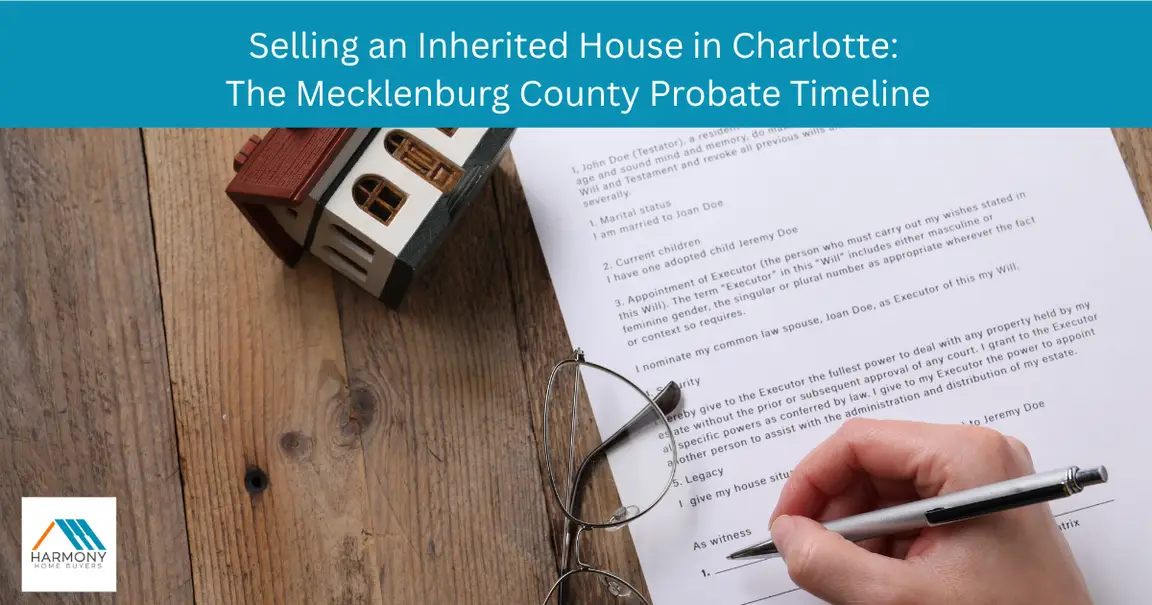
You can sell an inherited house in Charlotte, but usually not the instant you decide to — first, someone has to be legally appointed to act for the estate, and in Mecklenburg County that appointment runs through the Clerk of Superior Court. The good news is you often don’t have to wait for the entire estate to close before you sell. Routine Mecklenburg probate runs about four to six months, but a house can frequently go under contract well before that. Here’s how the timeline actually works and where a sale fits into it.
I’m Ryan Whitcher with Harmony Home Buyers here in Charlotte. A lot of the families we sit down with are in exactly this spot: a parent passed, the house is now theirs, and they’re staring at a place full of a lifetime of belongings while trying to figure out what they’re even allowed to do with it. One Charlotte seller, Maria, came to us after losing her father — alone in the family home they’d shared, more house than she needed, and the whole estate to settle. What she needed wasn’t a fast flip; it was a respectful sale that gave her time and space to do it right. That’s the reality behind most inherited-home sales, and it’s why understanding the process matters before you rush anything.
First: North Carolina Has No Separate Probate Court
This surprises people. In North Carolina, there’s no standalone probate court — the Clerk of Superior Court acts as the probate judge. In Charlotte, that’s the Estates Division of the Mecklenburg County Clerk of Superior Court, located at 832 East 4th Street, Suite 2400, Charlotte, NC 28202. That office is where the estate gets opened, where the paperwork lives, and where the authority to sell the house comes from.
You generally want to file the will within about 30 days of the death, and the estate should typically be opened within roughly 60 days. Once it’s opened, the Clerk issues the document that actually matters for selling the house.
The Document That Unlocks the Sale
You cannot sign a sale contract for a dead person’s house on your own say-so. You need court-issued authority:
- Letters Testamentary — issued when there’s a valid will naming an executor.
- Letters of Administration — issued when there’s no will, and the court appoints an administrator.
Whichever applies, that document is your proof of authority. Until someone holds it, the estate has no one who can legally sign to sell. This is the single most common thing that trips up families who think they can list Mom’s house the week after the funeral.
The Mecklenburg Timeline, Start to Finish
Here’s the realistic sequence for a Charlotte estate:
- File the will / open the estate: within ~30–60 days of death.
- Qualification and Letters issued: the executor or administrator is formally appointed.
- Creditor claim period: North Carolina builds in roughly a 90-day window for creditors to file claims against the estate.
- Inventory due: within 3 months of qualification (NCGS §28A-20-1), you file an inventory of estate assets.
- Estate closes: routine Mecklenburg estates commonly wrap in ~4–6 months; more complex ones run 6–12 months or longer.
Now the part that saves families months of frustration: you usually don’t have to wait for the estate to fully close to sell the house. Once someone is formally appointed and holds Letters, the property can often go under contract using an open-estate indemnity agreement that lets the sale proceed while the estate is still open. Someone must be appointed first — that’s non-negotiable — but full closure of the estate is not always a prerequisite to a signed contract.
When You Might Skip Full Probate Entirely
If the estate is small, North Carolina offers a shortcut. A small estate affidavit is available when the probate assets fall under $20,000 — or under $30,000 if the surviving spouse is the sole heir (NCGS §28A-25-1). Whether a house pushes you over that threshold depends on equity and how title is held, so ask an estate attorney rather than guessing.
Why Inherited Charlotte Homes Often Sell As-Is
Inherited houses tend to come with three things that make a traditional listing hard: deferred maintenance, a house full of belongings, and multiple heirs who don’t all agree.
The maintenance is real here. Many inherited Charlotte homes are older properties where decades of small repairs were put off — and this region’s Piedmont clay quietly works on foundations over the years, so an inherited older home can carry issues the family never knew about. Pouring money into repairs on a house you’re trying to let go of rarely makes sense. Add the emotional weight of the “lifetime of belongings” Maria faced, and the reality that a clean fixed-price sale often keeps the peace among siblings better than a listing where everyone second-guesses every offer.
The Real Math: List the Inherited House vs. Sell As-Is
Say you’ve inherited a Charlotte home worth about $340,000 fully updated, but it needs roughly $30,000 of work and is full of belongings.
Scenario A — Clean it out, repair, and list: ~$30,000 in repairs out of pocket (coordinated among heirs), plus a full-house cleanout in cost and weeks of family labor, plus a 5–6% agent commission (~$17,000–$20,400), plus holding costs — taxes, insurance, utilities on an empty house — across the current ~40–70 day Charlotte days-on-market and another 30–45 days to close. Net: higher gross price, but months of coordinated effort and real out-of-pocket cost split among people who may not agree.
Scenario B — Sell as-is once you hold Letters: no repairs, no commission, cleanout usually handled for you (take what you want, leave the rest), and a timeline frequently in the 7–14 day range once you’re appointed and clear to sell. Net: a lower gross price, but no repairs, no cleanout, no commission, and one clean number to divide among heirs.
If the heirs agree, the house is in good shape, and nobody’s in a rush, listing nets more — that’s the honest answer. As-is cash earns its place when there’s multi-heir disagreement, out-of-state heirs, deferred maintenance, or a house no one can face emptying.
How We Handle Inherited-Home Sales
We confirm you’re clear to sell
We’ll ask whether the estate is open and whether you hold Letters. If you’re not there yet, we can still talk timeline and often structure around an open estate — but we won’t pretend you can sign before you’re appointed.
We buy as-is, belongings and all
Take the photo albums and the heirlooms; leave the furniture and whatever you don’t want. You don’t clean it out.
You set the pace
Some families want it done in two weeks. Others, like Maria, need breathing room. We work to your timeline.
As Tim, another Charlotte-area seller, said about selling his parents’ home: professional, impeccable communication, and the whole process took less than 30 days. That’s the goal — clear and respectful, not rushed.
FAQ: Selling an Inherited House in Charlotte
Q: How soon can I sell an inherited house in Charlotte? A: Once you’re formally appointed by the Mecklenburg County Clerk of Superior Court and hold Letters Testamentary or Letters of Administration, the house can often go under contract — frequently before the full estate closes, via an open-estate indemnity agreement.
Q: Do I have to finish probate before selling? A: Usually not the entire process. Someone must be appointed and hold Letters first, but the sale can often proceed while the estate remains open.
Q: What if there are several heirs who disagree? A: A fixed-price cash sale gives everyone one clear number to divide, which often reduces conflict compared to a listing where each offer reopens the debate. The appointed executor or administrator signs on the estate’s behalf.
Q: The house is full of my parent’s belongings — do I have to clear it out? A: Not with an as-is cash sale. You take what matters to you and leave the rest; a cash buyer handles the cleanout.
Q: What’s a small estate affidavit? A: A North Carolina shortcut (NCGS §28A-25-1) available when probate assets are under $20,000, or under $30,000 if a surviving spouse is sole heir. It can avoid full administration for modest estates — ask an estate attorney whether the house keeps you under the threshold.
Q: Should I talk to an attorney? A: For anything beyond a simple estate, yes. I’m not an attorney, and probate has real legal and tax consequences — an estate attorney or CPA is worth the consultation before you sign anything.
The Bottom Line
An inherited Charlotte house isn’t something you can sell overnight, but it’s also not something you have to wait a year to move — once you’re appointed through the Mecklenburg County Estates Division and hold Letters, you have room to act. Decide honestly whether the heirs, the condition, and the timeline point toward listing for top dollar or an as-is sale that trades some price for no repairs, no cleanout, and one clean number to split. And loop in an estate attorney for the legal side.
If you want to see how an as-is inherited-home sale would pencil out against your situation, we’re glad to walk through it with no pressure and on your timeline.
Settling an estate and need to sell a home in the Charlotte area? Contact us or call (704) 285-2485.